
Before implementing a hybrid research approach, create a well-structured plan that clearly defines research questions, data collection techniques, and analysis methods. Establish a realistic timeline for each phase and ensure all critical decisions are mapped in advance. Strong planning builds a solid foundation and helps avoid confusion, delays, or inconsistent outcomes throughout the research process.
Survey for Research
The survey research is a systematic approach that involves gathering information from individuals through their responses to questions and aims to draw conclusions.
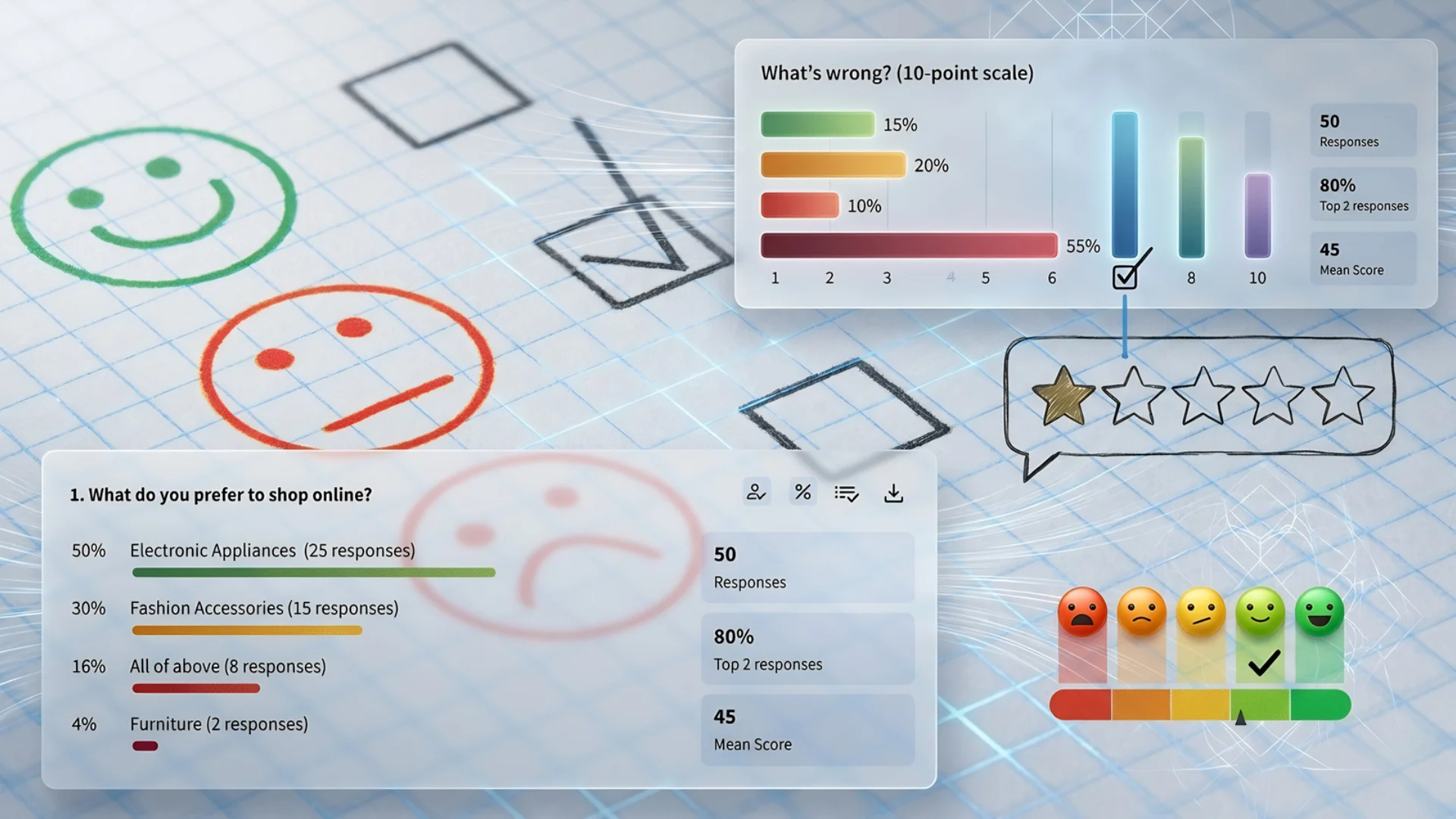
What is Survey for Research
A survey is a technique for collecting data from individuals through a set of questions, used to gather opinions or feedback on specific topics. Question formats include multiple-choice, open-ended, and rating scales, and surveys can be conducted online, by phone, or on paper. Researchers analyze survey data to identify trends and make informed decisions, which can guide product development, inform policy, or evaluate initiatives. Dr. Dillman defines a survey as a systematic method for understanding phenomena by gathering information from a representative sample, highlighting the importance of clear objectives and sample selection in survey design.
Top Industries Using Survey Research
Market Research & Consulting
Survey research is most widely used in the market research industry to understand customer behavior, preferences, brand perception, and demand trends. Businesses rely on survey data to make strategic decisions and validate ideas before launching products or campaigns.
Retail & E-commerce
Retail brands use surveys to measure customer satisfaction, purchase intent, pricing sensitivity, and shopping experiences. These insights help improve product offerings, personalize marketing strategies, and enhance overall customer journeys.
Healthcare & Pharmaceuticals
Healthcare organizations conduct surveys to understand patient experiences, treatment effectiveness, service quality, and public health trends. Survey data supports policy planning, service improvements, and medical research initiatives.
Education & Academic Research
Educational institutions and researchers use surveys to collect student feedback, learning outcomes, curriculum effectiveness, and research data. Surveys help institutions make evidence-based decisions and improve academic programs.
Technology & Product Development
Tech companies conduct survey research to evaluate user experience, feature demand, usability issues, and innovation opportunities. These insights guide product roadmaps and help companies build solutions that align with real user needs.
Characteristics Of Survey
What Makes a Survey Truly Intelligent?
Not just questions — it’s a system designed for accuracy, logic, and real insights.
Step 01
Precision Sampling
Select the right audience with relevant demographics to ensure meaningful and reliable insights.
Demographics
Targeting
Screening
Step 02
Smart Question Design
Well-structured questions and the right rating scales drive better responses and deeper insights.
Nominal
Ordinal
Interval
Ratio
Step 03
Adaptive Logic Flow
Skip logic and branching ensure respondents only see relevant questions based on their answers.
Skip Logic
Branching
Piping
Step 04
Insight-Driven Methods
Use structured methods, incentives, and follow-ups to collect accurate and actionable data.
Methods
Incentives
Follow-ups
Step 01
Precision Sampling
Select the right audience with relevant demographics to ensure meaningful and reliable insights.
Demographics
Targeting
Screening
Step 02
Smart Question Design
Well-structured questions and the right rating scales drive better responses and deeper insights.
Nominal
Ordinal
Interval
Ratio
Step 03
Adaptive Logic Flow
Skip logic and branching ensure respondents only see relevant questions based on their answers.
Skip Logic
Branching
Piping
Step 04
Insight-Driven Methods
Use structured methods, incentives, and follow-ups to collect accurate and actionable data.
Methods
Incentives
Follow-ups
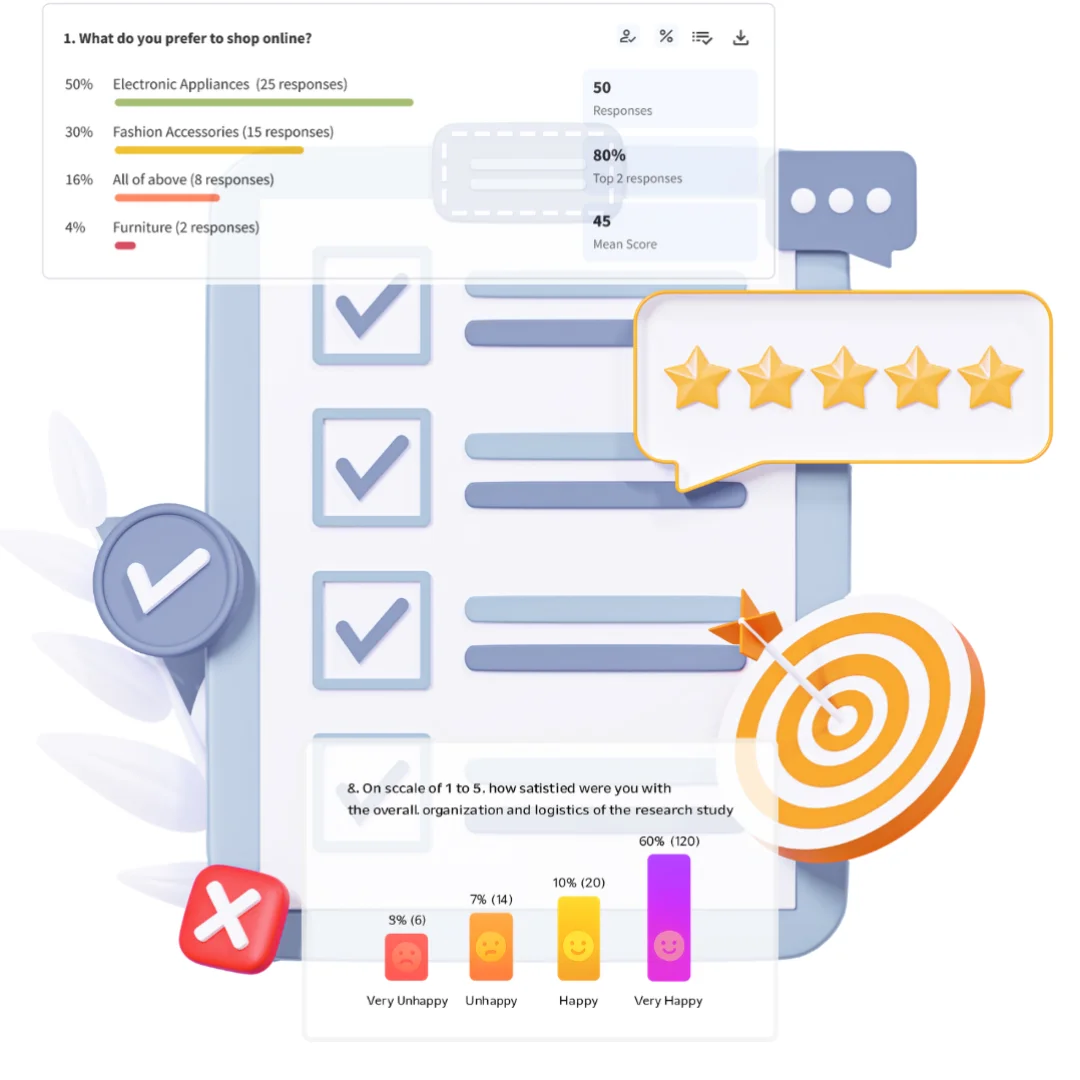
Key Highlights of Survey Research
-
Collects Direct Audience Insights Survey research helps organizations gather first-hand feedback from target audiences, enabling a deeper understanding of opinions, needs, and expectations.
-
Supports Data-Driven Decision Making Structured survey responses provide measurable data that businesses can analyze to make informed strategic and operational decisions.
-
Identifies Market Trends and Patterns Surveys help track changing customer behaviors, emerging preferences, and industry trends over time.
-
Enhances Customer Experience By understanding satisfaction levels and pain points, organizations can improve products, services, and overall user journeys.
-
Validates Ideas and Product Concepts Surveys are useful for testing new concepts, features, pricing strategies, or campaigns before full-scale implementation.
-
Flexible and Scalable Research Method Surveys can be conducted across multiple channels such as online platforms, mobile apps, phone interviews, or in-person formats.
-
Captures Both Quantitative and Qualitative Data Combining rating scales, multiple-choice, and open-ended questions allows researchers to gain both statistical insights and detailed feedback.
-
Cost-Effective and Time Efficient Compared to many traditional research methods, surveys enable faster data collection from large audiences with relatively lower costs.
Key Highlights of Generative AI
-
Collects Direct Audience Insights Survey research helps organizations gather first-hand feedback from target audiences, enabling a deeper understanding of opinions, needs, and expectations.
-
Supports Data-Driven Decision Making Structured survey responses provide measurable data that businesses can analyze to make informed strategic and operational decisions.
-
Identifies Market Trends and Patterns Surveys help track changing customer behaviors, emerging preferences, and industry trends over time.
-
Enhances Customer Experience By understanding satisfaction levels and pain points, organizations can improve products, services, and overall user journeys.
-
Validates Ideas and Product Concepts Surveys are useful for testing new concepts, features, pricing strategies, or campaigns before full-scale implementation.
-
Flexible and Scalable Research Method Surveys can be conducted across multiple channels such as online platforms, mobile apps, phone interviews, or in-person formats.
-
Captures Both Quantitative and Qualitative Data Combining rating scales, multiple-choice, and open-ended questions allows researchers to gain both statistical insights and detailed feedback.
-
Cost-Effective and Time Efficient Compared to many traditional research methods, surveys enable faster data collection from large audiences with relatively lower costs.
What is Survey Software?
Survey software is a versatile tool for gathering feedback through various formats using a computer-assisted approach. It features drag-and-drop tools and automation for designing, sending, and analyzing surveys efficiently online. This software is applicable in areas such as customer feedback, employee satisfaction, post-event analysis, market research, and academic assessments, allowing users to ask pertinent questions, engage audiences, and derive actionable insights for impactful change.

Benefits Of Survey
Understanding Survey Methodology
Surveys empower organizations to gather scalable, reliable, and meaningful data that drives confident decisions.
01.
Efficient Data Collection
Surveys are a highly efficient way to gather data from many participants in a short timeframe. Modern online tools allow researchers to reach global audiences without physical interaction, which is ideal for large populations or limited resources.
02.
Standardized Data Collection
Because every respondent is typically asked the same set of questions in the same order, the data remains consistent and comparable across the entire sample.
03.
Anonymity
Surveys can offer respondents a sense of privacy. This anonymity often leads to more honest and candid answers, especially when dealing with sensitive or personal topics.
04.
Cost-Effective
Compared to other methods like in-person interviews or long-term longitudinal studies, surveys (especially digital ones) are relatively inexpensive to distribute and process.
05.
Provides Quantitative Data:
Surveys excel at providing measurable, numerical data that can be analyzed statistically to identify trends, averages, and patterns within a population.
06.
Insights into Attitudes and Beliefs
Beyond just facts, surveys are effective tools for uncovering the "why" behind behaviors—helping researchers understand the subjective opinions, preferences, and motivations of a group.
01
Efficient Data Collection
Surveys are a highly efficient way to gather data from many participants in a short timeframe. Modern online tools allow researchers to reach global audiences without physical interaction, which is ideal for large populations or limited resources.
02
Standardized Data Collection
Because every respondent is typically asked the same set of questions in the same order, the data remains consistent and comparable across the entire sample.
03
Anonymity
Surveys can offer respondents a sense of privacy. This anonymity often leads to more honest and candid answers, especially when dealing with sensitive or personal topics.
04
Cost-Effective
Compared to other methods like in-person interviews or long-term longitudinal studies, surveys (especially digital ones) are relatively inexpensive to distribute and process.
05
Provides Quantitative Data:
Surveys excel at providing measurable, numerical data that can be analyzed statistically to identify trends, averages, and patterns within a population.
06
Insights into Attitudes and Beliefs
Beyond just facts, surveys are effective tools for uncovering the “why” behind behaviors—helping researchers understand the subjective opinions, preferences, and motivations of a group.
Understanding the Difference
Qualitative and Quantitative Research
Qualitative research explores the subjective “why” by diving into personal emotions and deep meanings within natural settings. Conversely, quantitative research uses systematic, mathematical tools to transform observable phenomena into measurable statistical laws and broad patterns.
| Aspect | Qualitative Research | Quantitative Research |
|---|---|---|
| Approach | Subjective; researcher is closely involved | Objective; precise analysis |
| Purpose | Exploratory; generates insights | Definitive; tests hypotheses |
| Sampling | Purposive sampling | Random sampling |
| Data Collection | Verbal & descriptive data | Numerical & measurable data |
| Analysis Elements | Words, images, observations | Statistical data |
| Outcome Focus | Explores meaning & patterns | Examines cause & effect |
| Methods | Interviews, focus groups | Surveys, experiments |
| Result | Initial understanding | Actionable conclusions |
| Aspect | Qualitative Research | Quantitative Research |
|---|---|---|
| Approach | Subjective; researcher is closely involved | Objective; focuses on precise, unbiased analysis |
| Purpose | Exploratory; aims to generate ideas and insights | Definitive; aims to test hypotheses and make decisions |
| Sampling | Uses purposive sampling | Uses random sampling |
| Data Collection | Collects verbal, descriptive data | Collects measurable, numerical data |
| Analysis Elements | Words, images, observations | Statistical and mathematical data |
| Outcome Focus | Discovers patterns, meanings, and experiences | Examines cause-and-effect relationships |
| Methods | In-depth interviews, focus groups | Structured surveys, experiments, observations |
| Result | Builds initial understanding | Provides actionable conclusions |
The Research Spectrum
Survey Research Doesn't Choose Sides — It Connects Them.
By combining structured measurement with human perspective, surveys can generate both statistical clarity and contextual depth.
Qualitative Zone

Open-ended questions invite participants to share experiences in their own words, generating rich narrative data.
Exploratory insights surface themes, perceptions, and emotional undercurrents invisible to numeric measurement.
Why?
Tell me more…
How did it feel?
Mixed Methods Core

Rating scales paired with open responses deliver the precision of numbers and the depth of stories — in a single instrument.
This fusion reveals not just what is happening, but why — giving researchers a comprehensive, actionable view.
Qualitative Zone

Open-ended questions invite participants to share experiences in their own words, generating rich narrative data.
Exploratory insights surface themes, perceptions, and emotional undercurrents invisible to numeric measurement.
Qualitative vs Quantitative Survey Questions
Understanding the difference helps you choose the right approach for your research goals.
Quantitative Questions
Quantitative survey questions focus on measurable data that can be analyzed statistically. These questions help identify patterns, trends, and numerical insights.
• How many hours per week do people spend on social media?
• What percentage of students prefer online learning?
• How much do customers spend on a product?
• What is the average age of buyers of a specific car brand?
• How many people are vaccinated in a population?
Qualitative Questions
Qualitative survey questions explore experiences, opinions, and perceptions. They are used to understand deeper insights and human behavior.
• What are the experiences of parents raising a child with autism?
• How do patients perceive the quality of healthcare services in rural areas?
• What are the barriers to accessing mental health services among marginalized communities?
• How do teachers perceive the impact of technology on students' learning outcomes?
• What are the cultural values that shape the dietary habits of a particular community?
• How do employees experience workplace diversity and inclusion initiatives?
Research Methodology
Hybrid Research: How to Combine Qualitative & Quantitative Methods
A strong hybrid research approach depends on planning, sequencing, and consistency. When these three elements are aligned, teams can translate early qualitative insight into more precise quantitative validation.
01.
Ensure proper planning
02.
Never forget the golden rule
The golden rule of hybrid research is to begin with qualitative research and then move to quantitative analysis. This sequence helps uncover insights, behaviors, and patterns that guide the creation of more effective surveys. Starting qualitatively ensures respondents can provide meaningful input, making your quantitative data more relevant, focused, and actionable for better decision-making.
03.
Qualitative Zone
Consistency is essential when combining qualitative and quantitative methods in hybrid research. Use aligned methodologies, similar audience demographics, and preferably the same research team across both phases. This ensures insights translate seamlessly without discrepancies. Maintaining consistency improves accuracy, reliability, and comparability of results, ultimately leading to stronger and more trustworthy research outcomes.
What You Can Do with a Survey Research Tool
Turn raw feedback into actionable insights that drive smarter, data-backed decisions.

Understand Customer Needs
Learn what your audience values, expects, and truly wants.

Measure Customer Satisfaction
Track satisfaction, uncover issues, and improve experiences.

Validate Ideas & Product Concepts
Test ideas, features, and pricing before market launch.
Validate Ideas & Product Concepts
Test ideas, features, and pricing before market launch.

Conduct Market & Brand Research
Analyze awareness, perception, and competitive positioning.
Conduct Market & Brand Research
Analyze awareness, perception, and competitive positioning.

Evaluate Employee Engagement
Understand employee satisfaction and workplace improvement areas.

Track Trends & Consumer Behavior
Monitor changing preferences and evolving buying patterns.
Answers to help you get started
Survey research is a systematic method of collecting data by asking a group of people structured questions to understand their opinions, behaviors, or preferences. It helps generate insights that can be analyzed and applied to larger populations.
Survey research is broadly divided into quantitative (structured, numerical data) and qualitative (open-ended, descriptive insights). It can also be categorized as cross-sectional, longitudinal, or retrospective based on how data is collected over time.
Survey research helps organizations make informed decisions by providing reliable data on customer preferences, behaviors, and trends. It is widely used in marketing, public policy, healthcare, and social sciences.
Common methods include online surveys, telephone interviews, face-to-face interviews, and questionnaires. These methods allow researchers to gather data efficiently from a targeted audience.
Survey research is cost-effective, scalable, and capable of collecting data from large groups quickly. It provides measurable results that can be analyzed statistically to identify patterns and trends.
Some common challenges include biased responses, poorly designed questions, low response rates, and unrepresentative samples, which can affect the accuracy of results.