
Speech Transcription Technology
Global interactions can lead to misunderstandings due to language differences. Speech transcription converts conversations into text, improving clarity and transparency.
Speech Transcription: An Introduction
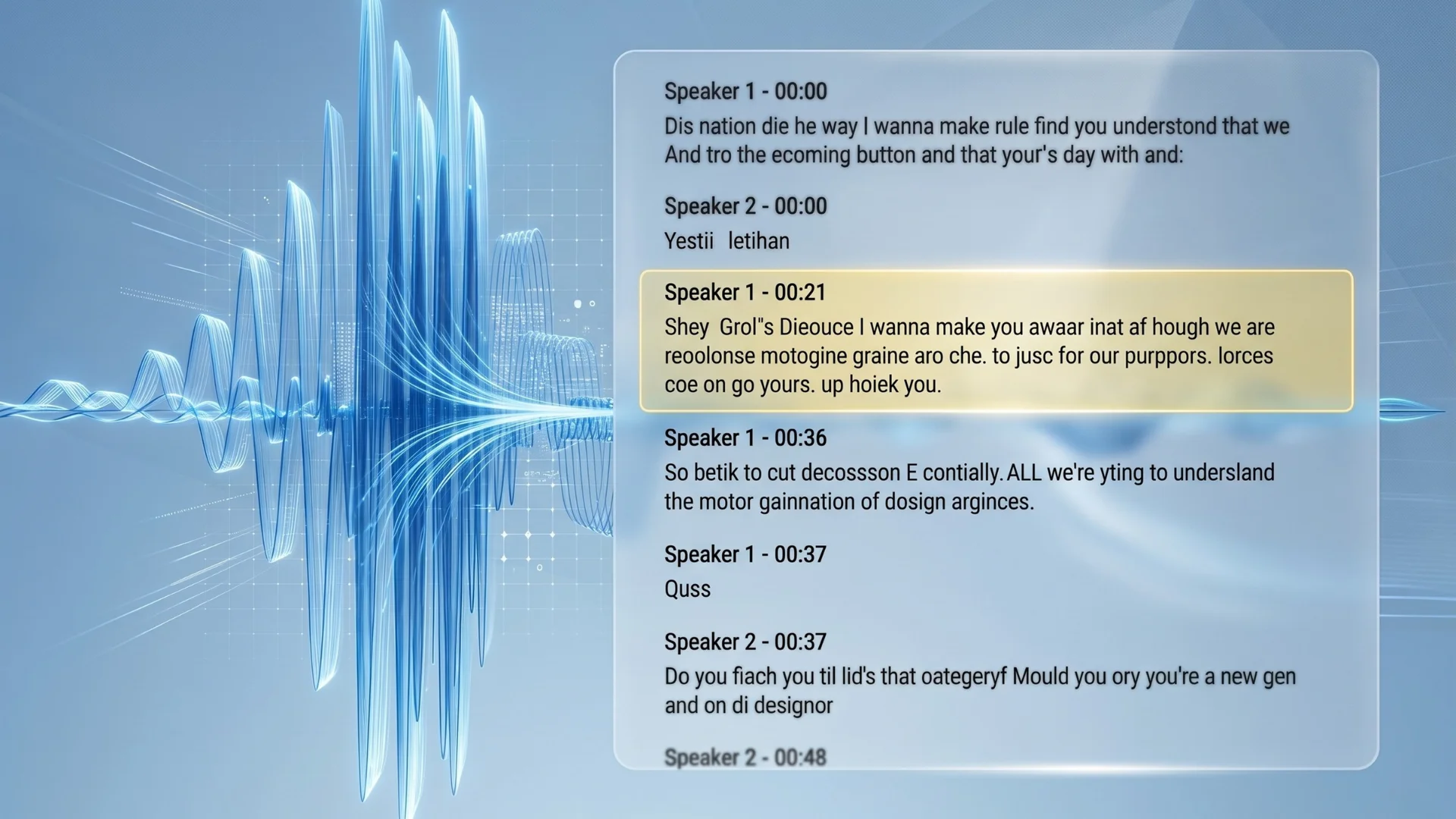
Speech transcription uses computers to interpret spoken audio and generate text through speech recognition technology. The mechanism behind this is signal processing, which processes the sound waves created by our vocal cords and recorded by a microphone to convert them into electrical signals. The processed signals are then used to isolate syllables and words, and over time, the computer can learn to understand speech through artificial intelligence and machine learning. The advantages of speech recognition technology include its ability to serve as a natural interface for programs that are not computer-based, resulting in its use in numerous applications.
Top industries using facial coding
Healthcare
Speech transcription is widely used for medical dictation and patient documentation. Doctors and healthcare professionals record notes, prescriptions, and case histories, which are then converted into accurate text. This reduces paperwork and improves efficiency.
Legal Industry
Law firms and courts use transcription to document hearings, depositions, and legal proceedings. Accurate transcripts help maintain official records, support case analysis, and ensure compliance.
Media & Journalism
Journalists, broadcasters, and content creators rely on transcription for interviews, speeches, podcasts, and video content. It speeds up content production and improves accessibility through subtitles and captions.
Market Research & Consumer Insights
Researchers use speech transcription to analyze interviews, focus groups, and customer feedback. It helps in faster data processing, behavioral analysis, and insight generation.
Sales & Customer Support
Sales teams use call transcription to review conversations, improve scripts, and understand customer needs. Customer service centers also use it for quality monitoring, training, and performance improvement.
Key Highlights of Our Speech Transcription
-
High Accuracy Transcription Our advanced AI models deliver highly precise transcripts with strong contextual understanding. Human review layers can be added to ensure near-perfect accuracy for critical use cases.
-
Real-Time & Fast Turnaround Convert live or recorded speech into text within seconds. This enables faster decision-making and improves operational efficiency across teams.
-
Multi-Language & Accent Support Our solution understands diverse languages, regional accents, and speaking styles. This helps organizations operate seamlessly in global and multilingual environments.
-
AI-Driven Contextual Understanding Powered by intelligent algorithms that recognize tone, intent, and conversational flow. This ensures transcripts are meaningful, structured, and easy to interpret.
-
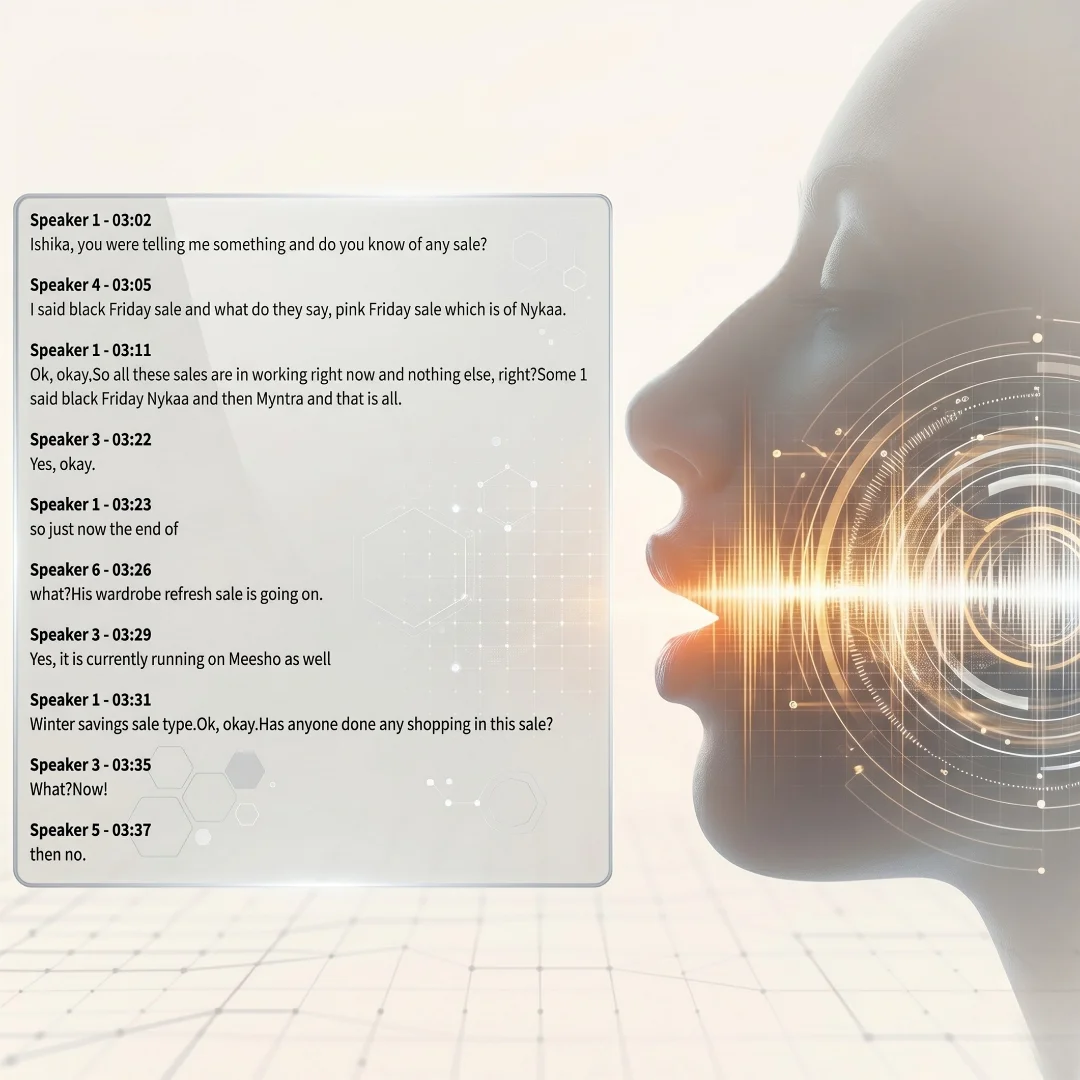
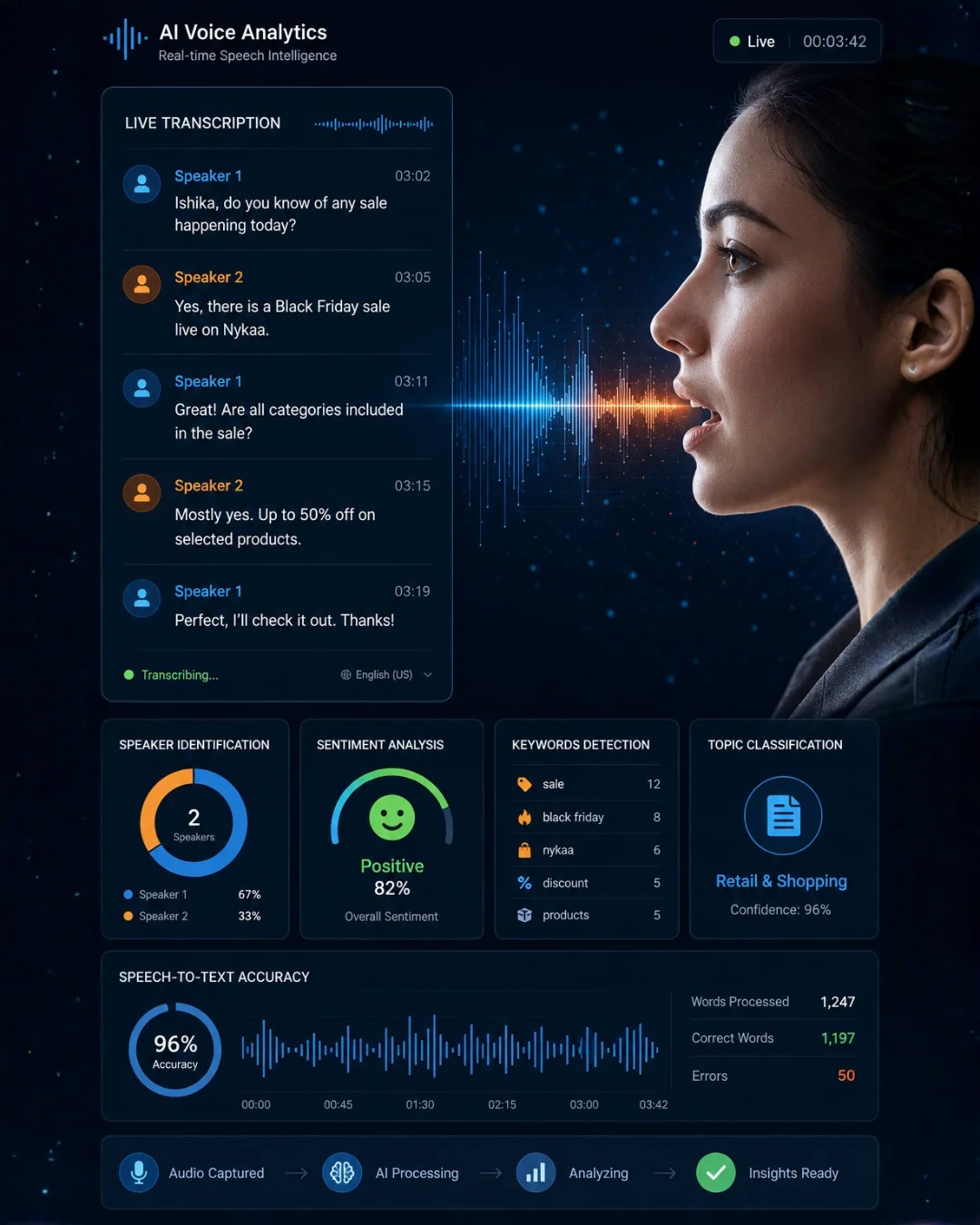
Smart Speaker Identification Automatically detects and labels multiple speakers in meetings, interviews, and calls. This improves clarity and makes conversations easier to review and analyze.
-
Enterprise-Grade Data Security We follow strict data protection protocols to keep sensitive audio and transcripts secure. Your information remains confidential and fully protected at every stage.
-
Insight-Ready Transcripts Get clean, formatted transcripts that are ready for analysis, reporting, and decision-making. This helps teams extract valuable insights without manual effort.
-
Seamless Integration & Scalability Our transcription services easily integrate with existing business tools and platforms. The solution scales effortlessly to handle growing volumes of audio data.
Key Highlights of Our Speech Transcription
-
High Accuracy Transcription Our advanced AI models deliver highly precise transcripts with strong contextual understanding. Human review layers can be added to ensure near-perfect accuracy for critical use cases.
-
Real-Time & Fast Turnaround Convert live or recorded speech into text within seconds. This enables faster decision-making and improves operational efficiency across teams.
-
Multi-Language & Accent Support Our solution understands diverse languages, regional accents, and speaking styles. This helps organizations operate seamlessly in global and multilingual environments.
-
AI-Driven Contextual Understanding Powered by intelligent algorithms that recognize tone, intent, and conversational flow. This ensures transcripts are meaningful, structured, and easy to interpret.
-
Smart Speaker Identification Automatically detects and labels multiple speakers in meetings, interviews, and calls. This improves clarity and makes conversations easier to review and analyze.
-
Enterprise-Grade Data Security We follow strict data protection protocols to keep sensitive audio and transcripts secure. Your information remains confidential and fully protected at every stage.
-
Insight-Ready Transcripts Get clean, formatted transcripts that are ready for analysis, reporting, and decision-making. This helps teams extract valuable insights without manual effort.
-
Seamless Integration & Scalability Our transcription services easily integrate with existing business tools and platforms. The solution scales effortlessly to handle growing volumes of audio data.
What You Can Do with Speech Transcription
From live discussions to lasting insights—convert speech into organized, actionable information effortlessly.

Real-Time Conversation Capture
Convert live conversations into instant text for better clarity and alignment.

Searchable Knowledge Creation
Turn speech into structured, searchable insights for quick access.

Smarter Meeting Documentation
Automatically generate transcripts and reduce manual note-taking.

Customer Interaction Intelligence
Analyze conversations to understand needs, sentiment, and improve performance.

Content Repurposing & Accessibility
Repurpose audio into blogs, captions, and accessible formats.

Compliance & Record Management
Maintain accurate records for transparency and regulatory needs.
How Speech Transcription Works
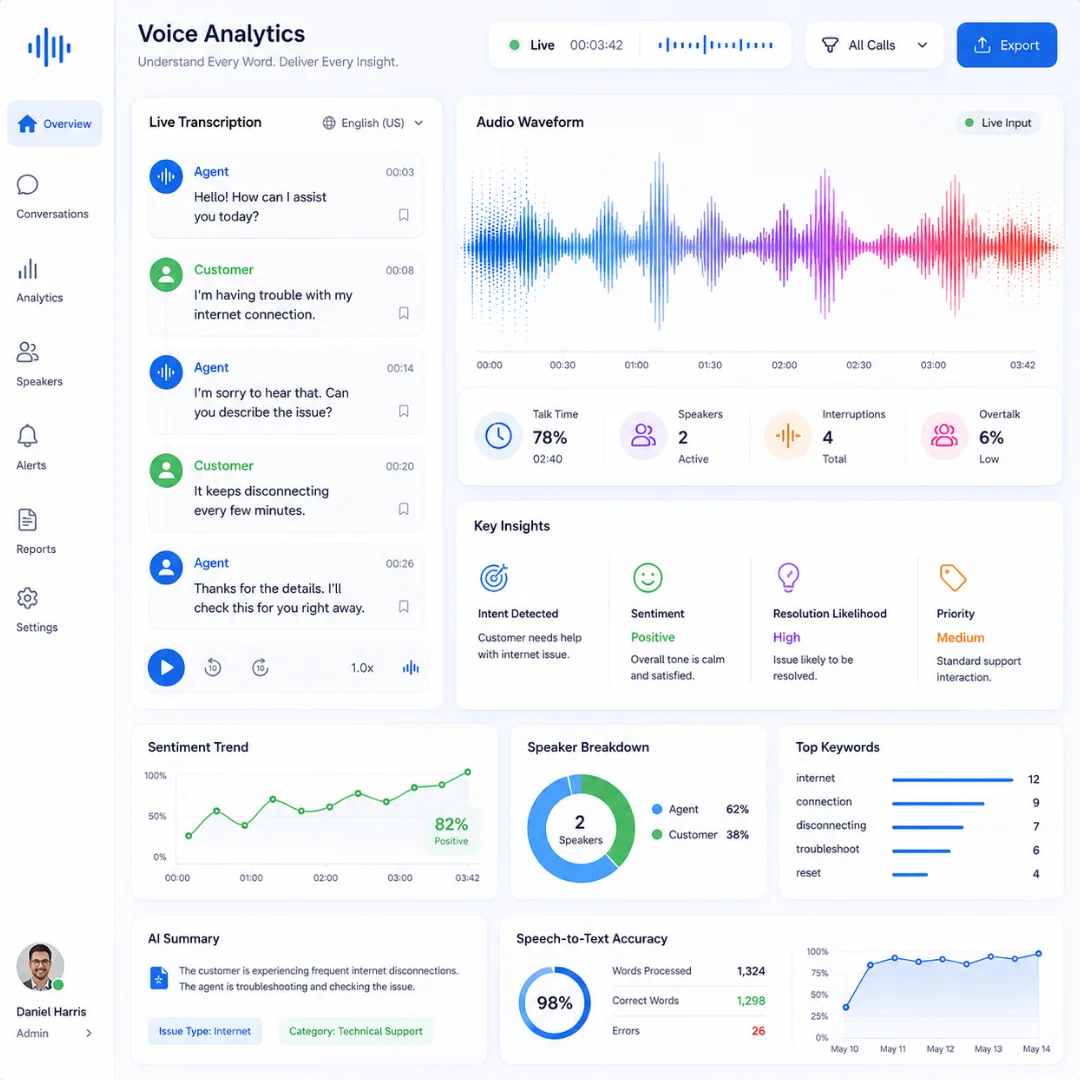
Speech transcription converts spoken language into accurate text using advanced AI. It captures nuances like tone, pauses, and context, making communication easy to record, search, and analyze.

Analog to Digital Conversion
Human speech creates sound vibrations that are naturally analogue signals. Speech transcription systems first capture these vibrations and convert them into digital audio data using an analog-to-digital converter.

Audio Filtering & Pre-Processing
The recorded audio is cleaned and filtered to remove background noise and irrelevant sounds.
This step ensures that only meaningful speech signals are analyzed for transcription.

Spectrogram Creation
The processed audio is transformed into spectrograms, which visually represent sound frequencies and timing patterns.
This allows AI models to identify speech elements, harmonics, and pronunciation variations.

Phoneme Segmentation
Speech is broken down into phonemes — the smallest sound units that differentiate words. The system compares these phonemes with trained language patterns to predict possible word formations.

Language Modeling & Character Integration
Advanced deep learning models combine phonemes into meaningful words, phrases, and sentences. Linguistic algorithms and contextual prediction help form grammatically correct and coherent text.

Final Transcript Generation
The system evaluates multiple transcription possibilities and generates the most accurate transcript using predictive modeling. The final output is delivered in standardized text formats such as Unicode for global compatibility.
Analog to Digital Conversion
Human speech creates sound vibrations that are naturally analogue signals. Speech transcription systems first capture these vibrations and convert them into digital audio data using an analog-to-digital converter.
Audio Filtering & Pre-Processing
The recorded audio is cleaned and filtered to remove background noise and irrelevant sounds.
This step ensures that only meaningful speech signals are analyzed for transcription.
Spectrogram Creation
The processed audio is transformed into spectrograms, which visually represent sound frequencies and timing patterns.
This allows AI models to identify speech elements, harmonics, and pronunciation variations.
Phoneme Segmentation
Speech is broken down into phonemes — the smallest sound units that differentiate words. The system compares these phonemes with trained language patterns to predict possible word formations.
Language Modeling & Character Integration
Advanced deep learning models combine phonemes into meaningful words, phrases, and sentences. Linguistic algorithms and contextual prediction help form grammatically correct and coherent text.
Final Transcript Generation
The system evaluates multiple transcription possibilities and generates the most accurate transcript using predictive modeling. The final output is delivered in standardized text formats such as Unicode for global compatibility.
💡 Simple Explanation
“Speech-to-text software listens, processes, understands, and converts spoken words into accurate written text using AI.”
The Evolving Landscape of AI-Powered Speech Transcription
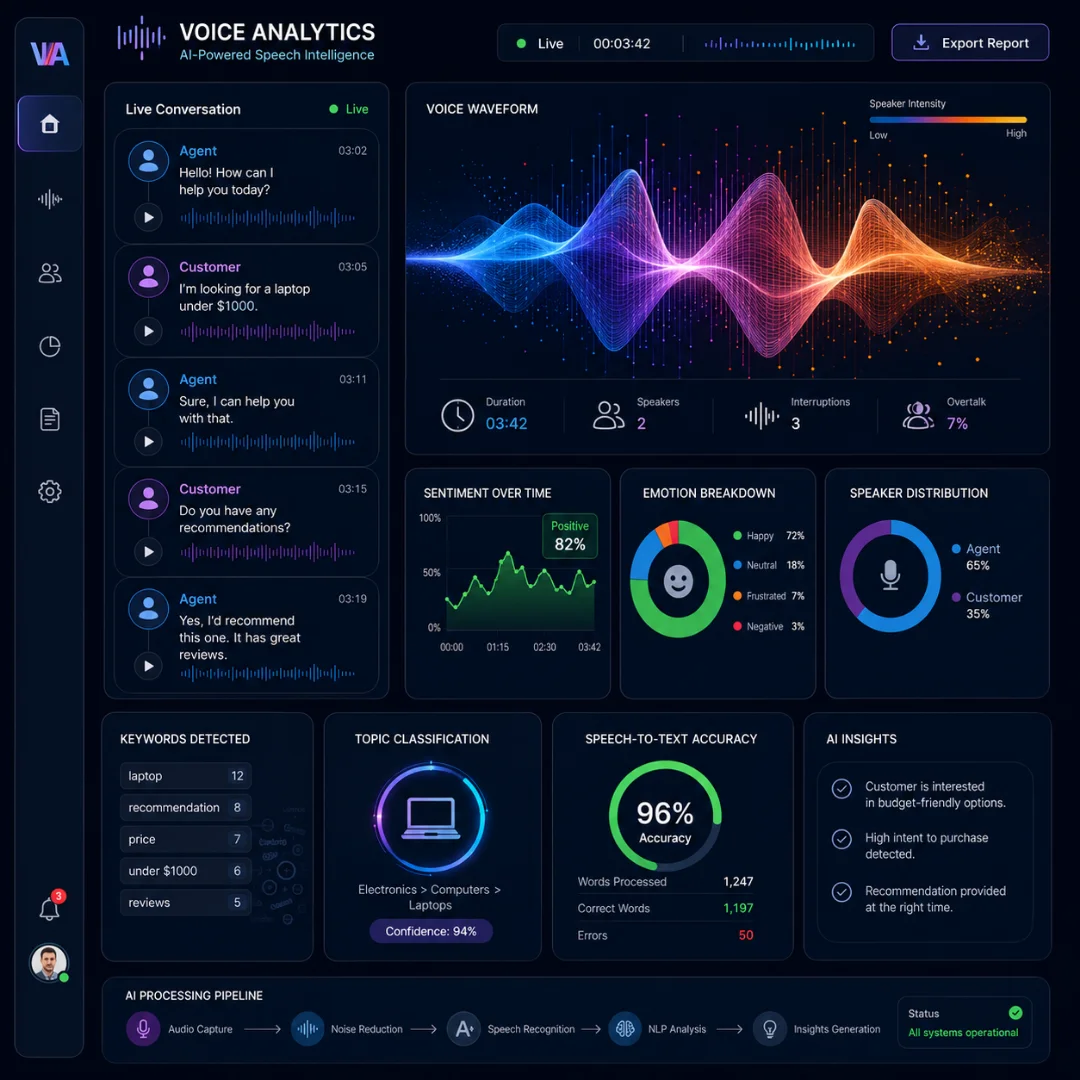
Speech transcription technology is rapidly transforming as artificial intelligence continues to advance. Modern solutions are no longer limited to simply converting audio into text — they now focus on understanding context, intent, and conversational meaning. This evolution enables businesses to unlock deeper insights from spoken interactions and make more informed decisions.
Artificial Intelligence
Artificial Intelligence drives the overall capability of modern transcription systems by simulating human-like understanding. It enables intelligent speech interpretation, helping systems recognize patterns, speakers, and complex audio environments more effectively.
Machine Learning
Machine Learning improves transcription accuracy by learning from vast speech datasets and real-world usage patterns. Over time, this continuous learning process enhances performance, reduces errors, and delivers faster, more reliable transcription results.
Natural Language Processing
Natural Language Processing strengthens transcription by helping systems understand tone, language nuances, and conversational flow. This deeper linguistic analysis allows organizations to extract meaningful insights rather than just capturing spoken words.
Hybrid Approach Highlight
Despite significant technological advancements, AI transcription still benefits from human expertise. A hybrid approach that combines intelligent automation with human validation ensures higher precision, contextual correctness, and consistently reliable speech-to-text outcomes across industries.
Key Applications
Voice Search
Smart Assistants
Conversational Analytics
Accessibility Solutions
Business Decision Intelligence
Voice Search
Smart Assistants
Conversational Analytics
Accessibility Solutions
Business Decision Intelligence
AI That Converts Speech to Text
Explore leading AI-powered speech recognition platforms that transform spoken conversations into accurate and actionable text.
Google Speech-to-Text
A powerful cloud-based speech recognition API converts both real-time and pre-recorded audio into accurate text. It employs advanced machine learning, supports multiple languages and dialects, facilitating global communication and scalable automation.
Real-time Transcription
Multi-language Support
API Integration
Amazon Transcribe
An intelligent speech recognition service that automatically transforms spoken audio into structured text across various formats. With built-in speaker differentiation and confidence scoring, it helps teams improve transcription reliability and streamline review processes.
Speaker Identification
Confidence Scores
Cloud Processing
Microsoft Azure Speech-to-Text
A scalable enterprise-grade transcription platform that supports both real-time and batch audio processing. It allows customization through domain-specific language models and speaker recognition, making it ideal for industry-focused applications and advanced analytics workflows.
Real-time Processing
Custom Models
Enterprise Ready
Apple Siri
A conversational voice assistant powered by speech recognition and natural language understanding. Siri enables users to interact with devices using voice commands, helping them send messages, make calls, control media, and perform everyday digital tasks effortlessly.
Voice Assistant
NLP Powered
Device Integration
Speech recognition transcriptionists: A new role on offer?
A speech recognition transcriptionist converts spoken words into written text using specialized software, engaging with audio recordings or live speech to create transcripts. They are employed across various industries, including healthcare, legal, and media, where they transcribe medical dictation, court proceedings, and interviews, respectively. Essential skills for these professionals include exceptional listening and typing abilities, along with knowledge of grammar and punctuation. Industry-specific expertise, such as familiarity with medical terminology or legal jargon, is often required, and employers may seek candidates with certification or formal training in speech recognition technology or transcription.
Two Ways AI Understands Human Voice
From capturing full conversations to enabling real-time interaction, modern voice technologies are transforming how humans communicate with digital systems. Understanding the difference between speech transcription and speech recognition helps organizations choose the right solution for documentation, automation, and intelligent user experiences.
• Documentation Intelligence
Speech Transcription
01
Transforms spoken conversations into structured and searchable text. Designed for insight generation, compliance documentation, and large-scale knowledge capture without restricting how users speak.
Key Capabilities
- Context-rich conversation capture
- Open response processing
- Meeting and research documentation
- Insight extraction and analysis
• Interaction Intelligence
Automatic Speech Recognition
02
Enables voice to act as a command interface for digital systems. Built on predefined grammars and response prediction models to deliver fast, guided, and action-driven user experiences.
Key Capabilities
- Voice-driven navigation
- Real-time system triggering
- IVR and assistant integration
- Structured response handling
How speech transcription can be used for market research

Better Administration
Using transcription services for market research can reduce administrative time and speed up the research process with fast turnaround times, even for automated transcriptions. They can prepare analysis-ready transcripts during interviews, freeing time to focus on essential tasks like analyzing data and gaining insights. With streamlined workflows, you can reach your target audience and collect more data to understand their behaviors better.

Reduced Overhead Costs
Outsourcing market research transcription is a cost-effective strategy that can enhance workflow efficiency and reduce overhead costs. Transcriptionists’ rates may vary by location, and using contract-based services minimizes in-house productivity demands. While automated transcription services are cheaper and less accurate, they can assist in preliminary data handling before human refinement of key data sets.

Added Value to Market Research
Transcripts enhance the overall value of research by enabling customizable deliverables that can be easily shared with stakeholders and clients. They also allow marketing teams to repurpose spoken content into blogs, reports, or digital assets that support search visibility and audience engagement. Additional capabilities such as sentiment analysis and API integrations can further help researchers generate faster and more precise insights from structured datasets.

Accuracy in Data Extraction
High-quality human transcription services can deliver exceptional accuracy, helping reduce researcher bias and ensuring contextual understanding of participant responses. Verbatim transcripts preserve the original intent and nuance of conversations, which is essential for reliable data analysis, credible research reporting, and confident decision-making.
Centralized and Searchable Database
Market research transcription enables the creation of a centralized database where interviews, focus groups, and discussions can be organized and accessed easily. Researchers can search for specific keywords, themes, or participant responses based on demographics, allowing them to quickly navigate large datasets and retrieve relevant information without wasting time.
How Speech Transcription Helps in Sales Enablement
Sales call transcripts provide a valuable tool for sales managers to engage in one-on-one reviews with their reps, encouraging the habit of active listening. You can analyze the conversation flow using insight-driven call transcription to identify areas where representatives need improvement. It includes identifying if reps sound robotic or are picking up on subtle cues from prospects to tailor the conversation. It also involves assessing if agents allow natural pauses in the conversation to let clients speak and reveal their needs, as well as whether they are appropriately responding to what the caller is saying and adapting their responses based on the caller's tone. By actively listening to these transcripts, reps can address their weaknesses and develop effective sales scripts to create a powerful connection with their target audience and deliver a memorable customer experience.
Contrary to popular belief, call transcripts identify sales reps' mistakes and recognize their positive accomplishments. Call recordings and transcripts can highlight exceptional performances from your team members, such as high customer satisfaction scores or excellent objection-handling skills. This approach motivates other team members to adopt successful strategies and improve their sales game.
Call recordings and transcriptions offer a significant advantage by allowing coaches to extract relevant insights efficiently. Using speech analytical tools, customer conversations can be transcribed, and practical coaching examples can be quickly found and shared with the team. Unfortunately, sales managers spend most of their time dealing with routine administrative tasks, which could be automated, leaving only a tiny percentage of their time for coaching. However, conversation intelligence platforms can provide valuable insights from real-time customer interactions, allowing managers to identify successful and struggling reps and tailor their coaching sessions accordingly. It helps personalize coaching sessions to meet the needs of each sales agent, saving time and increasing effectiveness. Further, it also helps in improving the efficiency of the overall sales team as a group. It can be challenging to manage a large sales team, especially when you have multiple agents making hundreds of calls each day. Speech transcriptions offer a comprehensive view of the team's performance, allowing you to track key sales metrics and pinpoint improvement areas. This information can be used to organize group training sessions where you can review common challenges sales reps face during the week and provide tips and examples to help them better navigate demanding customers and sales scenarios. Speech transcripts are highly beneficial for introducing new representatives too. They can be utilized to construct a comprehensive collection of favorable and unfavorable instances, which can aid other team members in learning how to handle complex situations. Creating an internal knowledge base that sales representatives can refer to may be advantageous when confronted with an unfamiliar problem.
To monitor your team's performance effectively, there are more efficient approaches than randomly selecting calls to review. It offers you better opportunities to coach your team and identify critical issues. Using a conversation intelligence tool provides searchable transcripts to monitor specific keywords. You can set up alerts for keywords like "cancel" or "angry" to quickly identify issues and provide solutions to customers, ultimately reducing customer churn.
Eye tracking involves collecting sensitive data about a person's gaze patterns, which raises concerns about privacy and ethical considerations.
Eye tracking technology has its limitations in terms of application. It may not be suitable for certain types of research, such as studying natural gaze behavior in real-world environments.
Despite advances in eye-tracking technology, there is room for improvement, particularly when tracking eye movements during quick and complex actions, such as reading or playing sports.
Building perceptions: Eye movements are closely associated with the visual attention of a person. It is impossible to move your eyes without also moving your attention. However, it is possible to shift attention without moving your eyes. Therefore, although eye tracking can provide information about what people are looking at and seeing, it cannot provide insights into their perception.
Answers to help you get started
Speech transcription technology converts spoken audio from meetings, calls, interviews, or videos into written text using artificial intelligence and language processing algorithms. It helps businesses document and analyze conversations efficiently.
Modern AI transcription solutions offer high accuracy, especially with clear audio quality and minimal background noise. Accuracy can be further improved with customization, speaker training, and human review if required.
Yes, many transcription platforms provide real-time transcription for live meetings, webinars, and customer calls. This allows teams to capture insights instantly and take faster actions.
Advanced speech transcription systems are designed to understand multiple languages, dialects, and regional accents. This makes them ideal for global teams and diverse customer interactions.
Enterprise-grade transcription solutions follow strict data security protocols, including encryption and secure storage. This ensures confidential audio files and transcripts remain protected.
Industries such as healthcare, legal, media, market research, sales, customer support, and education widely use speech transcription to improve documentation, analysis, and operational efficiency.